In 2026, homeowners face a narrowing window to maximise their solar investment returns. Federal STC rebates are stepping down, grid export approval processes have been updated for larger systems, and the federal battery rebate drops from $336 to $272 per usable kWh from May 2026. Choosing a CEC-accredited installer before these changes take full effect can save thousands of dollars.
The solar market has never been more active, and it has never been more important to understand the changing rules before signing a contract. The updates affecting solar installation in 2026 are not dramatic in isolation, but each one gradually reduces the financial benefit of waiting. Together, they represent a meaningful shift that informed homeowners are already responding to.
More than 30% of households now have solar panels installed, one of the highest adoption rates globally. Yet many homeowners are still undecided, and for that group, the message is clear: the best time to solar installers was three years ago, the second best time is now.
Key Takeaways
- Federal STCs step down each January; a 6.6kW system installed in 2026 generates $220–$300 less in rebate value than the same system installed before 31 December 2025
- The Cheaper Home Batteries Program battery rebate drops from $336 to $272 per usable kWh from May 2026
- Energex now processes systems over 5kW with a detailed assessment that can add up to 5 weeks to approval timelines
- Queensland’s legacy 44c feed-in tariff closed to new customers and is winding down by 2028
- Current Queensland feed-in tariffs sit at 8.7 to 15 cents per kWh; self-consumption and battery storage now deliver superior returns
- CEC accreditation is a non-negotiable requirement for any installer claiming STCs on your behalf
What Has Changed for Solar Installers in 2026-27?
The solar landscape in 2026 has been reshaped by a combination of federal scheme changes, network rule updates, and shifting incentive structures. The cumulative effect is clear: timing now plays a more important role in solar investment decisions than it has in recent years.
The federal Small-scale Renewable Energy Scheme (SRES) continues to operate, but its built-in phase-down mechanism reduces the STC rebate value slightly each year.
“Every January, the deeming period shortens by one year, and that directly reduces the number of certificates a system generates. For a Brisbane household installing a 6.6kW system, the difference between installing in late 2025 versus early 2026 is roughly $220 to $300 in lost rebate. Multiply it across a 10kW system with battery and the gap is more significant.”, Andrew Colley, Director, Halcol Energy, a leading Brisbane solar company
This is not a scare tactic; it’s a scheduled reduction built into the scheme’s legislation from its inception.
The state-specific Battery Booster program closed in May 2024, removing an additional incentive layer that many homeowners previously relied on. What remains is the federal cheaper home batteries program, which continues to operate but is scheduled to step down in May 2026.
The CEC (Clean Energy Council) accreditation system remains the gold standard for verifying Brisbane-based installers and also maintains an approved products list, and only panels and inverters from that list qualify for STC claims. Choosing an unaccredited installer or a system with off-list products means forfeiting your rebate entirely.
Read More About: STC Solar Rebates: A Complete Guide
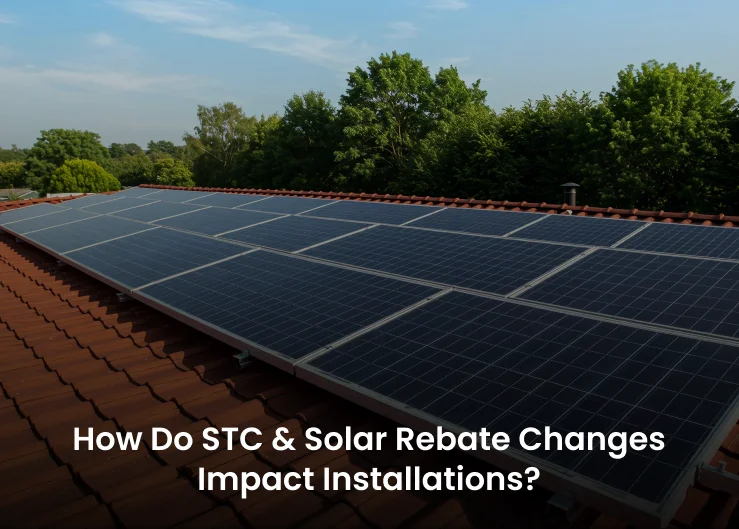
How Do STC Changes Affect Solar Installation Costs?
The STC rebate system is based on a formula that accounts for system size, geographic zone, and the remaining years in the SRES scheme. Higher-yield solar zones generate more certificates per kilowatt of installed capacity, increasing the overall rebate value.
For a standard 6.6kW system installed in 2026, the STC rebate typically comes to around $1,600 off the total system cost, applied as an upfront discount by your accredited installer. This figure was closer to $1,820 for the same system installed in early 2025, reflecting the annual step-down.
For homeowners comparing quotes, this explains why a 2026 quote for the same system may appear slightly higher than one from six months earlier. The price per certificate hasn’t changed significantly, but fewer certificates are issued each year.
The practical implication is that solar installation remains highly subsidised, but the level of support is gradually declining on a known schedule. For example, installing a 10kW system with a 13.5kWh battery before the May 2026 rebate reduction can deliver over $2,000 more in combined incentives compared to installing after mid-2026. That’s a meaningful difference for anyone planning a system this year.
What Are the Energex Export Limit Updates for 2026?
The key change is the processing time and approval pathway for systems above 5kW.
For systems at or below 5kW, approval is typically granted within an hour of application. For systems above 5kW up to 15kW, the detailed assessment process can take up to 5 weeks. Grid saturation in some suburbs has become a real network management challenge, and more rigorous technical reviews are now standard.
For systems at or below 5kW, Energex approval is typically granted within an hour of the installer’s application. For systems above 5kW up to 15kW, the detailed assessment process can now take up to 5 weeks. Grid saturation in some solar installers suburbs has become a real network management challenge, and Energex is applying its technical review process rigorously as a result.
Export limits remain in place under Energex’s standard residential connection agreement. Single-phase connections can export up to 5kW; three-phase connections can export up to 15kW. Homeowners wanting to install larger systems should discuss dynamic export enabling with their installer. The Energex solar connections page outlines the dynamic export framework, which allows real-time adjustment of export limits during periods of low network demand, but it requires compatible inverter technology.
|
Confused by Energex Rules and STC Changes? |
Battery Rebate Changes: What QLD Homeowners Must Know
Queensland homeowners have two primary battery incentive mechanisms available in 2026. The first is the federal cheaper home batteries program, which provides a tiered discount applied at the point of purchase through your accredited installer. The second is the feed-in tariff structure, which indirectly determines how much value stored solar energy generates compared to grid export.
The current federal battery rebate for systems installed between January and April 2026 is $336 per usable kWh. From May 2026, that drops to $272 per usable kWh. Full details on the program’s step-down schedule are published on the Australian Government’s Cheaper Home Batteries Program page. The calculation for a 10kWh usable capacity battery works out to a rebate of $3,360 before May and $2,720 after, a difference of $640. For a 20kWh battery, the difference is $1,280.
The solar rebate under the SRES scheme applies to the solar panel component separately from the battery incentive. Systems installed in high-yield solar zones generate more STCs per kilowatt, increasing the overall rebate value.
Combined, a typical 6.6kW solar system with a 10kWh battery installed before May 2026 can attract around $4,500 to $5,500 in total incentives, depending on system specifications and STC spot pricing.
The legacy 44c feed-in tariff closed to new customers and is scheduled to wind down by 2028. For homeowners not already on this legacy tariff, the current Queensland rate ranges from 8.7 to 15 cents per kWh. This makes battery storage considerably more attractive: storing daytime solar to use at night avoids paying 25 to 30 cents per kWh from the grid during evening peak hours.
“With feed-in tariffs now as low as 8.7 cents and grid power costing three times that in the evening, the economics of battery storage in Brisbane have fundamentally changed. A battery isn’t an upgrade anymore, it’s part of the base case.”, Andrew Colley, Director, Halcol Energy
Read More About: What’s Changing in Solar Battery Rebates for Brisbane in 2026
How Should Homeowners Respond Before May 2026?
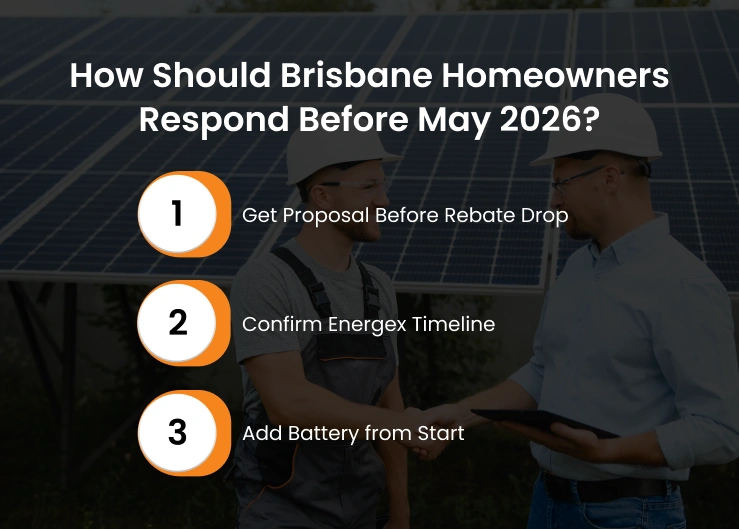
Step 1: Get a Proposal Before the May Battery Rebate Drop
Get a proper proposal from a CEC accredited solar company before the May 2026 battery rebate reduction. The proposal should include the exact STC rebate calculation based on your chosen system and installation date, so you can see the real net cost. This step alone can mean the difference between capturing $336 per kWh or only $272 per kWh on your battery component.
Step 2: Confirm the Energex Connection Timeline
Confirm the Energex connection timeline with your installer if your preferred system is above 5kW. An April 2026 submission may not result in installation until June, so factor this into your planning. If your preferred system sits at exactly 5kW inverter capacity, it qualifies for the faster approval pathway and avoids the potential five-week wait.
Step 3: Include Battery Storage in Your Initial Installation
Consider whether battery storage should be part of your initial installation rather than a later add-on. Adding a battery at initial installation is almost always cheaper than retrofitting it later, and it qualifies for the current battery rebate rate. Separating the solar and battery installation into two separate jobs typically costs 15 to 25% more due to duplicate call-out and certification charges.
The pattern is consistent: incentive values decline each year, electricity prices rise, and the case for delay weakens. For homeowners still considering solar power installation Brisbane, the three steps above offer a clear and low-risk path to move forward with confidence.
|
Lock In Your Solar Savings Before Rebate Changes |
Conclusion
Homeowners who act in April or May 2026 are best positioned to capture the highest available incentives before both the battery rebate reduction and further STC step-downs take effect. Contact us today to speak with a solar specialist and get your proposal before the incentive window closes.
FAQs
What solar rebates are available in 2026?
Homeowners can access STCs under the SRES scheme, which typically provide around $1,600 in upfront savings for a standard 6.6kW system. In addition, the federal battery rebate offers $272 per usable kWh from May 2026, reduced from $336 earlier in the year. These incentives are usually applied as point-of-sale discounts through accredited installers.
How long does solar approval take?
Approval timelines depend on system size. Systems up to 5kW are generally approved within hours, while systems between 5kW and 15kW can take up to 5 weeks due to detailed network assessment. Most installations are completed within 6–10 weeks from contract to commissioning.
Is the 44c feed-in tariff still available?
No, the 44c feed-in tariff is no longer available for new customers and is being phased out completely by 2028. Current feed-in rates are much lower, typically ranging between 8.7 and 15 cents per kWh depending on your energy retailer. This shift makes self-consumption and battery storage more valuable.
Why is installer accreditation important?
Accreditation is required for installers to claim STCs on your behalf, which directly reduces your system cost. It also ensures the installer meets industry standards, uses approved products, and follows proper installation practices. Choosing a non-accredited installer can result in losing rebate eligibility.
When is the best time to install solar in 2026?
The best time to install is before May 2026, when the federal battery rebate reduces from $336 to $272 per usable kWh. Installing earlier also helps maximise STC value, as incentives decrease slightly each year. Acting early ensures better overall savings.