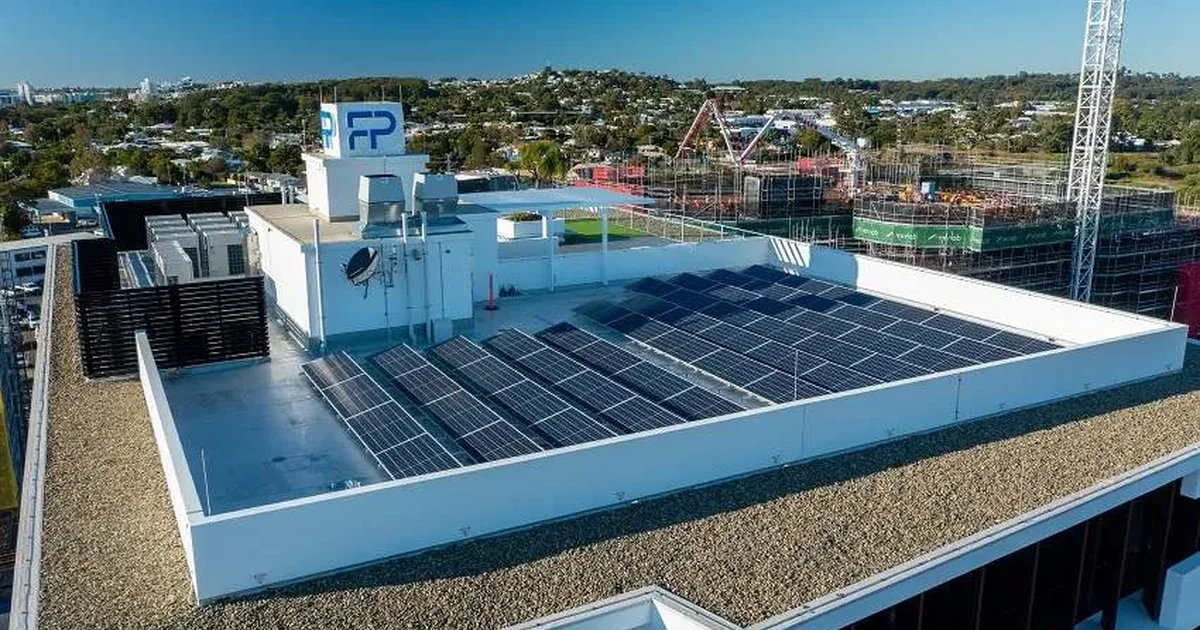
Commercial solar ROI in Brisbane typically lands between three and six years for most small-to-medium businesses, with the system then generating essentially free electricity for a further fifteen to twenty years of its working life. The exact number depends heavily on your business’s operating hours, energy usage pattern and roof space, which this guide breaks down with real figures rather than generic averages.
Key Takeaways
- Most Brisbane commercial solar systems pay for themselves within three to six years, depending on daytime energy use
- Businesses that operate mostly during daylight hours (retail, warehousing, manufacturing) see the fastest ROI since they consume solar power as it’s generated
- Instant asset write-off and depreciation rules can meaningfully shorten the effective payback period for eligible businesses
- System size should be matched to actual daytime load, not roof space alone, to avoid paying for excess export capacity you don’t need
- A properly sized commercial system typically delivers a 15-25% annual return on investment once fully paid off
What Counts as “ROI” for a Commercial Solar System
Return on investment for commercial solar isn’t just the headline payback period. It’s the combination of four things working together: the electricity you stop buying from the grid, any income from exporting surplus power, the tax and depreciation benefits available to Queensland businesses, and the avoided cost of future electricity price increases over the system’s lifetime.
Most online calculators only account for the first of these, which is why so many businesses end up with ROI estimates that look nothing like their actual bills once the system is installed. A proper commercial solar assessment accounts for all four factors against your specific usage pattern, not a generic business average.
Typical Payback Periods by Business Type
Payback periods vary significantly by how closely a business’s operating hours match daylight solar generation hours.
Retail stores and showrooms, which typically run from roughly 9am to 5pm and draw consistent power for lighting, air conditioning and refrigeration, tend to see payback within three to four years, since nearly all solar generation gets consumed directly rather than exported at a lower feed-in rate. This is the exact pattern our team sees across most commercial solar installation Brisbane projects with standard daytime trading hours.
Warehouses and light manufacturing facilities with daytime shifts and heavy equipment loads often see similarly fast paybacks, sometimes under three years, because their baseline energy draw during sunlight hours is high enough to absorb most of what a correctly sized system produces.
Businesses with lower daytime energy use relative to their roof space, or those operating mostly outside daylight hours, see longer payback periods in the five-to-seven-year range, since a larger share of generated power gets exported rather than directly offsetting a purchase.
Read More About: A Complete Guide to Commercial Solar Power Systems
The Four Levers That Actually Move Your ROI
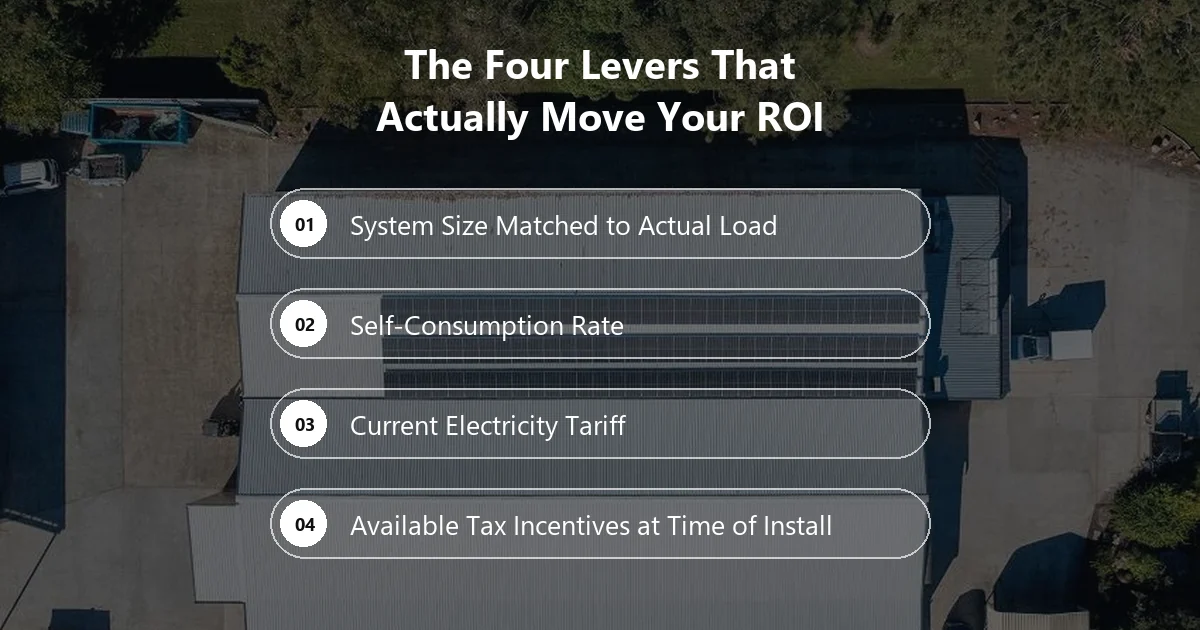
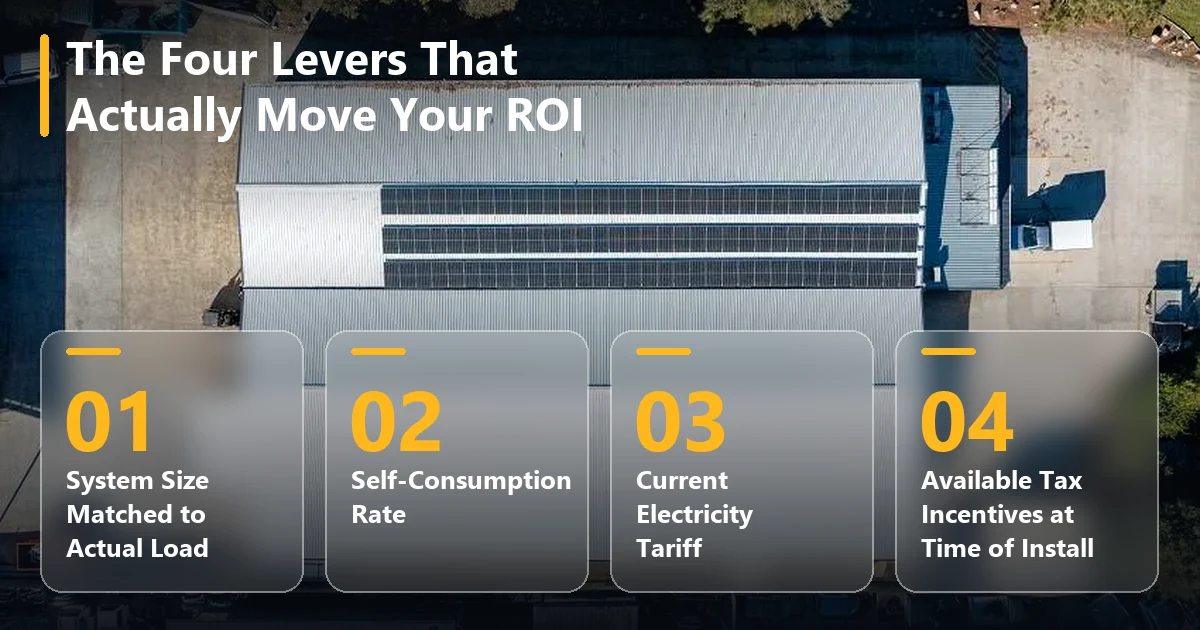
Four factors have the biggest real effect on commercial solar payback, more than any other variable business owners tend to focus on.
System Size Matched to Actual Load
Oversizing a system beyond what your business actually consumes during the day means a larger share of output gets exported at a lower rate instead of offsetting full retail electricity prices, stretching out the payback period unnecessarily.
Self-Consumption Rate
The percentage of solar power your business actually uses on-site, rather than exporting to the grid, is the single biggest driver of ROI. Businesses with high daytime, weekday energy use typically self-consume 70-90% of their solar generation.
Current Electricity Tariff
Businesses paying higher commercial electricity rates see faster payback simply because every kilowatt-hour of solar displaces a more expensive grid purchase. This makes solar particularly valuable for businesses on demand-based or time-of-use commercial tariffs.
Available Tax Incentives at Time of Install
Instant asset write-off thresholds and depreciation schedules change periodically, so the exact tax benefit available depends on when your system is installed and your business’s eligibility under current Australian Taxation Office rules.
|
Get a System Sized to Your Actual Daytime Load We assess your real energy usage pattern, not just your roof space, to recommend a system that maximises ROI rather than just maximising size. |
Depreciation and Tax Benefits for Queensland Businesses
Commercial solar assets are generally eligible for depreciation under standard Australian Taxation Office rules, and eligible businesses may also be able to claim an instant asset write-off depending on the asset value and current thresholds at time of purchase. These benefits effectively bring forward the tax deduction value of the system, improving cash flow in the years immediately following installation rather than spreading the benefit thinly across the system’s full depreciable life.
Because these thresholds and rules are updated periodically by the Australian Taxation Office, it’s worth confirming current eligibility with your accountant before finalising a commercial solar purchase, since the exact figures can materially change your effective payback period.
Solar vs Battery Storage for Commercial Properties
Most commercial solar ROI calculations focus purely on the solar panels and inverter, but adding battery storage changes the equation in a way that’s worth understanding before you decide whether it’s right for your business. Without a battery, any solar generation your business doesn’t use immediately during the day gets exported to the grid at a relatively low feed-in rate, which is fine for businesses with high daytime self-consumption but less valuable for those with lower daytime load.
A commercial battery lets a business store that excess daytime generation and use it to cover evening or early-morning load instead, or to provide backup power during a grid outage, which matters more for some industries than others. Businesses running refrigeration, server rooms, or other equipment that can’t tolerate downtime often find the backup power value of a battery justifies the investment on its own, separate from the pure energy-cost savings.
The ROI calculation for adding storage follows similar logic to solar alone: it depends on how much of the stored energy actually displaces an expensive grid purchase versus how much would have earned a reasonable export rate anyway. For businesses with a genuine evening or night-time load, or a real need for backup power, a battery can meaningfully improve the overall return on a combined solar and storage investment.
A Real-World Example: Retail and Warehouse Comparison
Consider two Brisbane businesses installing similarly sized 30kW commercial systems. A retail store trading six days a week, with consistent daytime refrigeration and air conditioning load, might self-consume close to 85% of its solar generation, bringing its payback period in around the three-and-a-half-year mark once depreciation benefits are included.
A warehouse operating a single daytime shift five days a week, with lighter baseline load outside of operating hours, might self-consume closer to 65% of generation, pushing payback out to roughly four-and-a-half to five years, still well within the system’s 25-year-plus expected working life.
In both cases, once the system has paid for itself, the remaining fifteen to twenty years of its life represent close to pure savings, since ongoing maintenance costs for a well-installed commercial system are minimal relative to the electricity costs avoided.
Read More About: Commercial Solar Install for Evans Built
How to Estimate Your Own Commercial Solar ROI
Start with twelve months of actual electricity bills rather than a single month, since commercial energy use often varies seasonally. From there, a proper assessment maps your hourly usage pattern against expected solar generation for your specific roof orientation and location, to estimate a realistic self-consumption rate rather than an industry average.
From that self-consumption figure, calculate the value of electricity directly offset at your current tariff rate, add any expected export income for surplus generation, then add the estimated tax and depreciation benefit for your business’s situation. Our solar energy calculator can give you a rough starting estimate, though a proper commercial assessment using your actual bills will always be more accurate. Divide total system cost by the combined annual benefit to arrive at a realistic payback period specific to your business, not a generic commercial average.
|
Skip the Generic Calculator, Get Real Numbers Our team will walk through your actual electricity bills and usage pattern to give you a genuine payback estimate for your business. |
What Happens After the System Pays for Itself
It’s worth dwelling on what happens once a commercial solar system reaches its payback point, since this is often underweighted in ROI conversations that focus purely on the years-to-payback number. A quality commercial system installed today typically carries a 25-year-plus performance warranty, meaning a business that reaches payback in year four still has roughly twenty-one more years of substantially free electricity ahead of it, aside from minor ongoing maintenance and the eventual cost of inverter replacement partway through the system’s life.
Over that extended period, the value of avoided electricity purchases compounds further if grid electricity prices continue to rise, which has been the general long-term pattern across the Australian market. A business that locked in its solar investment several years ago is now avoiding today’s higher grid rates entirely for the portion of its load covered by solar, which is a benefit that’s easy to overlook when the conversation stays focused narrowly on the initial payback period alone.
Mistakes That Blow Out Commercial Solar Payback Periods
The most common mistake is sizing a system to fill available roof space rather than matching it to actual daytime consumption, which leaves a business exporting a large share of generation at a low rate instead of offsetting full-price electricity.
The second common mistake is skipping a proper usage-pattern assessment and relying on a single average monthly bill, which can significantly misrepresent genuine daytime load for businesses with seasonal variation or multiple operating shifts.
The third is overlooking available depreciation and instant asset write-off benefits entirely when calculating payback, which can meaningfully understate the true return available to an eligible business in the years immediately following installation.
Conclusion
Commercial solar ROI in Brisbane comes down to matching system size to real daytime load, understanding your business’s self-consumption pattern, and factoring in available depreciation benefits rather than relying on a generic online calculator. Done correctly, most Brisbane businesses see a genuine three-to-six-year payback followed by well over a decade of substantially free electricity.
As an established Brisbane solar company, Halcol Energy has designed and installed commercial solar systems for businesses ranging from retail stores to warehouses across South-East Queensland. If you want a real ROI figure based on your actual electricity bills rather than an industry average, our commercial solar team can help.
FAQs
What's a typical payback period for commercial solar in Brisbane?
Most Brisbane businesses see payback within three to six years, depending on how closely their operating hours match daylight solar generation hours.
Does commercial solar ROI include tax benefits?
A proper ROI estimate should include eligible depreciation and instant asset write-off benefits, which can meaningfully shorten the effective payback period for qualifying businesses.
Is a bigger commercial solar system always a better investment?
No. A system sized beyond your actual daytime load means more power gets exported at a lower rate, which can stretch out payback rather than improving ROI.
How long do commercial solar systems last?
Quality commercial systems typically carry 25-year-plus performance warranties, meaning most of the system’s working life delivers savings well beyond the initial payback period.
Do warehouses benefit less from solar than retail stores?
Not necessarily, though self-consumption rates and therefore payback speed can vary based on daytime load intensity and operating hours, which a proper assessment accounts for.