Charging an EV with solar and a home battery means your car draws power your panels generated during the day, stored for use whenever you actually plug in, instead of pulling expensive grid electricity overnight. For most Brisbane and Sunshine Coast households, this single change cuts EV running costs close to zero once the system is sized correctly. The rest of this guide explains exactly how to set that up, what size battery you actually need, and where the real savings come from.
Key Takeaways
- A solar battery lets you store excess daytime solar generation and release it into your EV charger at night, instead of buying power back from the grid at peak rates
- Most Brisbane and Sunshine Coast homes need a 10-13.5kWh battery to comfortably cover an overnight EV top-up alongside normal household use
- Daytime charging direct from solar is the cheapest option when you’re home during the day, but a battery closes the gap for anyone who charges after work
- Smart chargers that talk to your solar inverter can automatically prioritise excess solar before drawing from the battery or grid
- Pairing an EV charger with an existing solar and battery package is usually cheaper than buying either system separately later
Why Pair an EV Charger With a Solar Battery
Most EV owners in South-East Queensland charge their car in the evening, after work, which is exactly when solar panels have stopped producing and grid electricity costs the most. Without a battery, that evening charge comes straight from the grid at full retail rate, often undoing a large share of the savings your solar system was supposed to deliver in the first place.
A home battery changes that equation completely. During the day, any solar power your household isn’t using gets stored in the battery instead of exported to the grid for a few cents a kilowatt-hour. When you plug your EV in that evening, the car draws from the battery first, using energy that effectively cost you nothing to generate. Depending on your driving habits, this can mean genuinely free fuel for your car most weeks of the year, a point we’ve also seen play out with our own free EV charger at the Sunshine Coast showroom.
How the System Actually Works, Step by Step
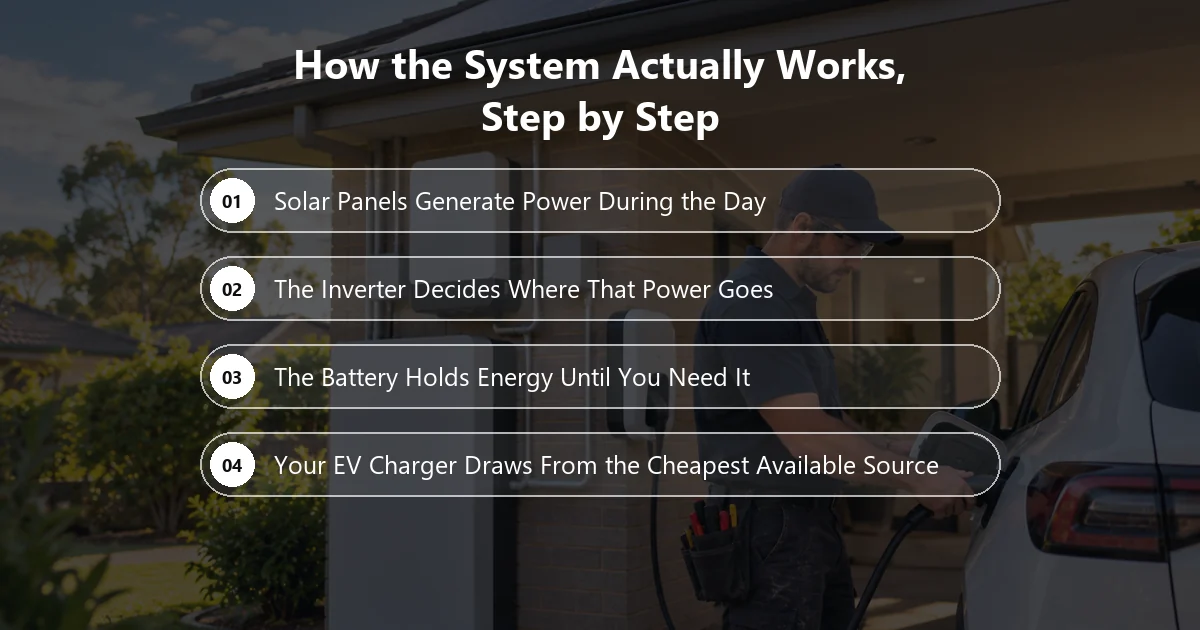
A combined solar, battery and EV charging setup follows a simple energy flow, even though the equipment behind it is genuinely sophisticated.
Step 1: Solar Panels Generate Power During the Day
Your panels produce electricity whenever the sun is up, regardless of whether anyone is home. On a typical South-East Queensland day, a 6.6kW system generates more power than an average household uses between roughly 9am and 3pm.
Step 2: The Inverter Decides Where That Power Goes
Modern hybrid inverters constantly balance three destinations for solar power: your home’s live usage, your battery, and the grid. Once household appliances are covered, excess generation charges the battery first and only spills over to the grid once the battery is full.
Step 3: The Battery Holds Energy Until You Need It
Instead of exporting leftover solar for a low feed-in tariff, the battery stores it for later. This is the step that makes evening EV charging affordable, since the energy sitting in the battery by 6pm was essentially free to produce.
Step 4: Your EV Charger Draws From the Cheapest Available Source
A properly configured setup prioritises battery and solar power before touching the grid at all. Smart EV chargers can be scheduled or app-controlled to charge only when solar or battery capacity is available, avoiding peak grid rates almost entirely. If you’re looking at EV charger installation for your own home, this solar-matching capability is the single most important spec to ask your installer about.
Read More About: Solar Batteries: All You Need to Know
What Size Battery Do You Need to Charge an EV?
This is the question most homeowners get wrong, usually by underestimating. A typical EV battery holds 50-75kWh, but you’re not trying to fill the entire car battery from your home battery every single night. Most drivers only need to replace 20-40km worth of daily driving, which is a far smaller energy draw than people expect.
For a household that also runs normal appliances overnight, a 10kWh to 13.5kWh home battery is usually enough to comfortably top up an EV alongside everyday use, provided the solar system charged it fully during the day. Larger families, bigger homes, or households charging two EVs will often benefit from stepping up to a 15kWh-plus system, which is exactly the kind of sizing decision covered in our solar and battery package options.
|
Not Sure What Battery Size Fits Your Home and EV? Every household’s driving and energy habits are different. Get a tailored battery and EV charger sizing recommendation from our accredited team, free of charge. |
Daytime Charging vs Battery-Stored Overnight Charging
If you’re home during the day and can plug your EV in between roughly 10am and 3pm, you may not need a battery at all to charge for free, since your panels are likely producing more than the house needs at that time anyway.
The problem is that most working households simply aren’t home during those hours. That’s exactly the gap a battery is built to close. Rather than losing that midday solar surplus to a low export tariff, the battery banks it and releases it the moment you plug in after work, keeping the cost of charging close to zero either way.
A well-designed system often uses both approaches together: direct solar charging on weekends or work-from-home days, and battery-stored charging on standard commuting days.
Peak vs Off-Peak Grid Rates and Where Solar Fits In
Most South-East Queensland electricity retailers charge noticeably more for power drawn during peak periods, typically the late afternoon and early evening window when everyone arrives home, switches on air conditioning, starts cooking dinner, and plugs in their EV at the same time. This is precisely the window where grid demand, and therefore pricing, tends to be highest.
A solar and battery system sidesteps this problem almost entirely. Because the battery was charged earlier in the day from free solar generation, your EV charging session during that expensive peak window draws from stored solar rather than the grid, regardless of what time-of-use tariff your retailer applies. For households on a time-of-use plan specifically, this single behaviour change, charging the car from the battery instead of the grid during peak hours, can be one of the largest individual contributors to overall household savings.
It’s worth checking your own electricity plan’s peak, shoulder and off-peak windows and rates, since the exact savings will vary depending on how aggressively your retailer prices peak-period usage. Some households also find it worthwhile to schedule any unavoidable grid-based EV charging for off-peak overnight hours instead, further reducing cost on nights when the battery alone isn’t enough to fully cover the charge.
Real Running Costs for South-East Queensland Drivers
To put real numbers on this, an average EV travelling 15,000km a year uses roughly 2,250-3,000kWh of electricity annually, depending on the vehicle. Charged entirely from the grid at typical South-East Queensland rates, that can cost several hundred dollars a year just in electricity.
Charged mostly from solar and a correctly sized battery instead, that same driving distance can cost close to nothing in additional electricity, since the energy would otherwise have been exported for only a few cents a kilowatt-hour anyway. The exact saving depends on your system size, driving distance and how much of your charging happens during daylight hours, but for most households the payback period on adding EV charging to an existing solar and battery system is considerably shorter than installing solar for the first time.
Read More About: How to Purchase the Best Solar Battery Storage System
Choosing the Right Charger and Battery Combination
Not every EV charger plays nicely with every solar and battery setup. A few things genuinely matter here:
Smart, app-connected chargers can read live solar production and automatically throttle charging speed to match available excess power, rather than pulling a fixed high current regardless of what your panels are producing. This “solar-matching” or dynamic load feature is the single most useful spec to look for if minimising grid draw is your priority.
Charger amperage also needs to suit your home’s wiring and your EV’s maximum charge rate. A 7kW single-phase charger suits most residential setups and typical overnight charging windows, while larger or three-phase chargers make more sense for households charging multiple vehicles or wanting a faster top-up.
Finally, make sure your inverter and battery brand are genuinely compatible with whichever EV charger you choose, since mismatched communication protocols can prevent the system from intelligently prioritising solar and battery power the way it’s meant to.
|
Get an EV Charger That Actually Talks to Your Solar System We install EV chargers alongside solar and battery systems as a single, properly integrated setup, not three separate products bolted together. |
Rebates and Incentives That Can Offset the Cost
Battery rebate programs available to Queensland households can meaningfully reduce the upfront cost of adding storage alongside an EV charger, though eligibility criteria, rebate amounts and application windows change periodically, so it’s worth confirming current availability before finalising a system design. Combining a battery rebate with the existing solar feed-in arrangement on your property often improves the overall payback calculation for the combined EV charging and storage setup.
It’s also worth checking whether your electricity retailer offers any EV-specific tariff plans, since some providers now offer discounted overnight or off-peak rates specifically aimed at EV owners, which can further reduce the cost of any charging that does draw from the grid rather than the battery.
Installation Timeline and What to Expect
For households adding an EV charger to an existing solar and battery system, installation is typically straightforward and can often be completed within a single day, since the core electrical infrastructure, switchboard capacity and inverter communication pathways are usually already in place. The main additional work involves running a dedicated circuit to the charger’s mounting location and configuring the charger to communicate with your existing inverter for solar-matching functionality.
For households installing solar, battery and EV charging all at once as a new combined system, the process generally takes a little longer, since it involves a full site assessment, system design tailored to your roof and usage pattern, and coordination of all three components to work together from day one. A proper site visit beforehand, rather than a remote quote based on satellite imagery alone, tends to produce a more accurate installation timeline and a system that’s genuinely sized for your household’s real needs.
Common Mistakes Homeowners Make
The most common mistake is undersizing the battery after already investing in solar, assuming any battery will do. A battery that’s too small for your household’s overnight usage plus EV charging simply runs flat before morning, forcing a grid top-up anyway.
The second most common mistake is installing an EV charger with no solar-matching capability, which means it draws full grid power regardless of whether the sun is shining, even during the middle of the day when excess solar is going to waste.
The third is skipping professional load assessment entirely. Every household’s driving pattern, appliance mix, and roof orientation is different, so a system sized for a neighbour’s home won’t necessarily suit yours.
Conclusion
Pairing an EV charger with a solar battery is one of the most effective ways to bring your car’s running costs close to zero, provided the system is sized correctly for your household’s actual driving and energy habits rather than a generic one-size-fits-all package. Getting the battery capacity, charger type and solar-matching configuration right from the start makes the difference between a setup that genuinely delivers free fuel most weeks and one that still leaves you paying peak grid rates every evening.
As a trusted solar and battery installer on the Sunshine Coast, Halcol Energy has helped thousands of South-East Queensland households design EV charging setups that work with their existing or new solar and battery systems, not against them. If you’re ready to see what a correctly sized system would actually save you, our team is here to help.
FAQs
Can I charge my EV directly from solar panels without a battery?
Yes, if you’re home during daylight hours. Without a battery, any charging done after dark draws from the grid at standard rates instead of stored solar.
How much battery capacity do I need just for EV charging?
Most households need 10-13.5kWh total, covering both normal overnight use and a partial EV top-up, depending on daily driving distance and existing appliance load.
Will adding an EV charger void my solar system warranty?
No, provided the charger is installed by an accredited electrician and wired correctly to your switchboard, separate from your inverter’s own warranted components.
Is it cheaper to charge an EV with solar than at a public charging station?
Almost always yes. Public DC fast chargers typically cost several times more per kilowatt-hour than home solar, and home charging also saves the time spent travelling to a public charger.
Do I need a separate meter for an EV charger on solar?
Most residential installs don’t require a separate meter, though your installer will confirm this based on your specific switchboard and charger capacity.